
Category: Data Science
-
The Problem with Data
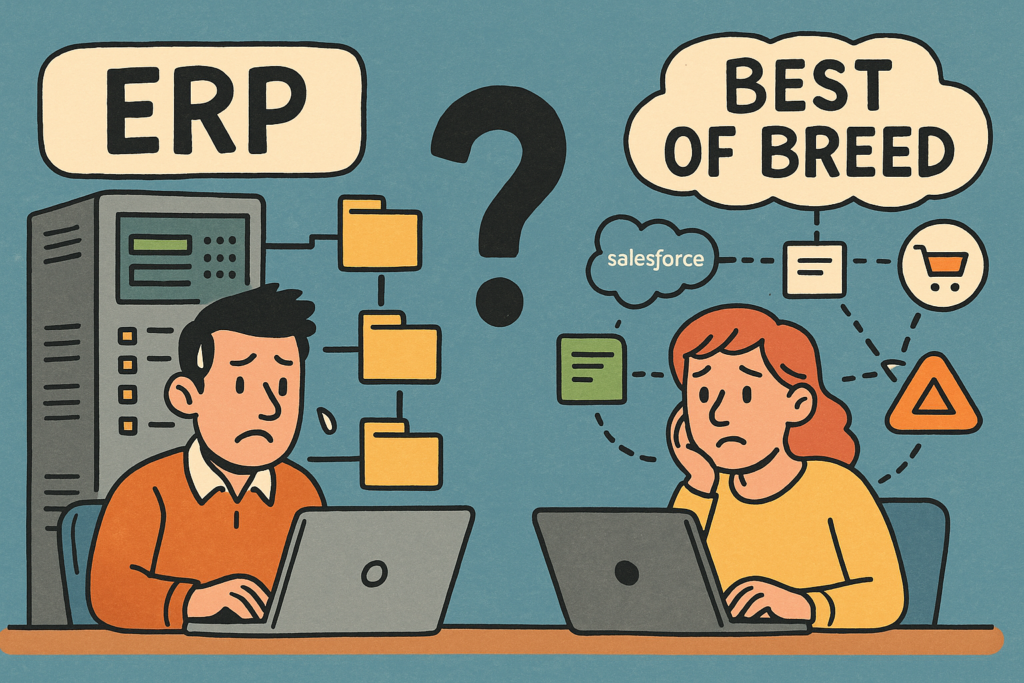
Everyone has the same problem, and its name is data. Nearly every business functions in one of two core data models:
- ERP-centric: One large enterprise system (like SAP, NetSuite, or Microsoft Dynamics) acts as the hub for inventory, customers, finance, and operations. It’s monolithic, but everything is in one place.
- Best-of-breed: A constellation of specialized tools – Salesforce or HubSpot for CRM, Zendesk for support, Shopify or WooCommerce for commerce, QuickBooks for finance – all loosely stitched together, if at all.
In reality, most businesses operate somewhere in between. One system becomes the “system of truth,” while others orbit it, each with its own partial view of the business. That setup is manageable until AI enters the picture.
AI is data-hungry. It works best when it can see across your operations. But ERP vendors often make interoperability difficult by design. Their strategy has been to lock you in and make exporting or connecting data expensive or complex.
That’s why more organizations are turning to data lakes or lakehouses, central repositories that aggregate information from across systems and make it queryable. Platforms like Snowflake and Databricks have grown quickly by helping enterprises unify fragmented data into one searchable hub.
When done well, a data lake gives your AI tools visibility across departments: product, inventory, sales, finance, customer support. It’s the foundation for better analytics and better decisions.
But building a good data lake isn’t easy. I joke in my book The AI Evolution, a bad data lake is just a data swamp, a messy, unstructured dump that’s more confusing than helpful. Without a clear data model and strategy for linking information, you’re just hoarding bytes.
Worse, the concept of data lakes was designed pre-AI. They’re great at storing and querying data, but not great at acting on it. If your AI figures out that you’re low on Product X from Supplier Y, your data lake can’t place the order; it can only tell you.
This is where a new approach is gaining traction: API orchestration. Instead of just storing data, you build connective tissue between systems using APIs, letting AI both see and do across tools. Think of it like a universal translator (or Babelfish): systems speak different languages, but orchestration helps them understand each other.
For example, say HubSpot has your customer data and Shopify has your purchase history. By linking them via API, you can match users by email and give AI a unified view. Better yet, if those APIs allow actions, the AI can update records or trigger workflows directly.
Big players like Mulesoft are building enterprise-grade orchestration platforms. But for smaller orgs, tools like Zapier and n8n are becoming popular ways to connect their best-of-breed stacks and make data more actionable.
The bottom line: if your data lives in disconnected systems, you’re not alone. This is the reality for nearly every business we work with. But investing in data cleanup and orchestration now isn’t just prep, it’s the first step needed to truly unlock the power of AI.
That’s exactly why we built the AI Accelerator at PerryLabs. It’s designed for companies stuck in this in-between state where the data is fragmented, the systems don’t talk, and the AI potential feels just out of reach. Through the Accelerator, we help you identify those key data gaps, unify and activate your systems, and build the orchestration layer that sets the stage for real AI performance. Because the future of AI isn’t just about having the data—it’s about making it usable.
-
Rise of the Reasoning Models
Last week, I sat on a panel at the Maryland Technology Council’s Technology Transformation Conference to discuss Data Governance in the Age of AI alongside an incredible group of experts. During the Q&A, someone asked about DeepSeek and how it changes how we think about data usage—a question that speaks to a fundamental shift happening in AI.
When I give talks on AI, I often compare foundation models—AI models trained on vast datasets—to a high school or college graduate entering the workforce. These models are loaded with general knowledge, and just like a college graduate or a master’s degree holder, they may be specialized for particular industries.
If this analogy holds, models like ChatGPT and Claude are strong generalists, but what makes a company special is its secret sauce—the unique knowledge, processes, and experience that businesses invest heavily in teaching their employees. That’s why large proprietary datasets have been key to training AI, ensuring models understand an organization’s way of doing things.
DeepSeek changes this approach. Unlike traditional AI models trained on massive datasets, DeepSeek was built on a much smaller dataset—partly by distilling knowledge from other AI models (essentially asking OpenAI and others questions). Lacking billions of training examples, it had to adapt—which led to a breakthrough in reasoning. Instead of relying solely on preloaded knowledge, DeepSeek used reinforcement learning—a process of quizzing itself, reasoning through problems, and improving iteratively. The result? It became smarter without needing all the data upfront.
If we go back to that college graduate analogy, we’ve all worked with that one person who gets it. Someone who figures things out quickly, even if they don’t have the same background knowledge as others. That’s what’s happening with AI right now.
Over the last few weeks, every major AI company seems to be launching “reasoning models”—possibly following DeepSeek’s blueprint. These models use a process called Chain of Thought (COT), which allows them to analyze problems step by step, effectively “showing their work” as they reason through complex tasks. Think of it like a math teacher asking students to show their work—except now, AI can do the same, giving transparency into its decision-making process.
Don’t get me wrong—data is still insanely valuable. Now, the question is: Can a highly capable reasoning model using Chain of Thought deliver answers as effectively as a model pre-trained on billions of data points?
My guess? Yes.
This changes how companies may train AI models in the future. Instead of building massive proprietary datasets, businesses may be able to pull pre-built reasoning models off the shelf—just like hiring the best intern—and put them to work with far less effort.