
Issue #85: AI Is Eating the Ladder from the Bottom
Howdy 👋🏾.
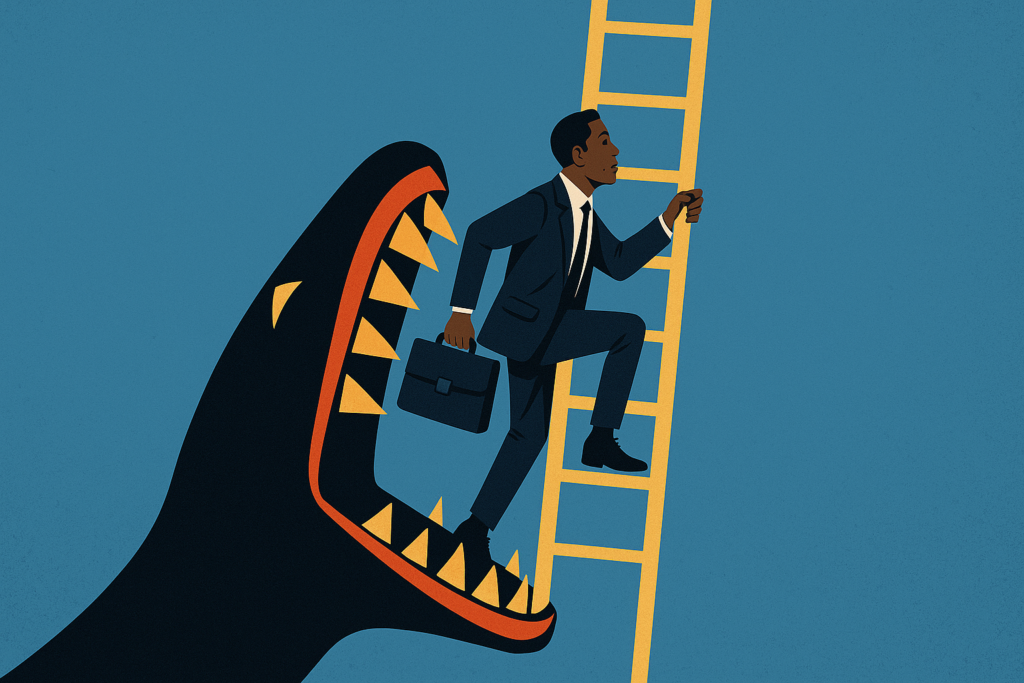
AI’s impact on jobs is finally showing up in the data. A new study from Stanford offers some of the first concrete evidence. As the report explains: “Young workers (ages 22–25) in the most AI-exposed jobs saw a 13% drop in employment compared to less-exposed peers, while older workers in the same roles experienced a 6–9% increase.” Software developers, customer service reps, and marketing & sales managers are among the roles seeing the sharpest divide between automation and augmentation.
On a panel at the Black is Tech conference in Houston, someone asked me if I would recommend getting a degree in computer science right now. My response was simple: some jobs just aren’t a great place to be. Not because they’re not important, but because it’s harder than ever to get your “10,000 hours” when AI handles so much of the entry-level work.
For those of us who’ve done the work for decades, we know this pattern. It’s like an orchestra, before you ever sit in the first chair, you spend time in the second and third, learning by doing, sharpening your ear, building instinct. But AI is rewriting that structure. Today, senior engineers in the first chair are being augmented by tools like Copilot and Claude Code, making them even more effective, while reducing or entirely removing the need for the seats behind them.
That’s the pattern: AI augmentation makes senior staff more productive, while automation quietly eats away at entry-level opportunities. A senior developer using AI doesn’t need as many junior devs. A marketing manager drafting campaigns with AI doesn’t need a big team. A conversational customer service bot that handles the easy questions means fewer frontline reps ever get involved.
That’s the thing, the nature of augmentation is circular. What augments one worker often automates another. It’s not a new phenomenon; technology has always driven efficiency. But efficiency often comes with a reshuffling of who’s needed, and where.
We often define ourselves by the lowest part of the value chain. A writer is someone who puts words on a page, but many people can do that. What matters is the storytelling, the framing, the depth of reporting. The same goes for software. We call someone a developer, but the real value may lie in how they architect solutions and think through edge cases, not how many lines of code they write. That’s the disconnect. Entry-level work tends to focus on the tactical: the output, the doing. Let the creative director be brilliant, and let others execute. But AI is now handling more and more of that tactical execution. What’s left is the thinking, the high-leverage work that has always sat in the first chair.
This is why being a true subject-matter expert only becomes more valuable as these tools mature. The explosion of vibe programmers, vibe marketers, and vibe-whatever-elsees shows how easy it is to look productive with AI. But the real unlock comes from pairing deep knowledge with the right tools for delivery. For a junior developer or writer who lacks that experience, AI can quickly become a crutch and prevent them from developing the higher-order thinking their role truly requires. For someone who already understands those intangibles, the tools offer scale. That’s why, for a senior person, these tools augment, while for entry-level, they often automate.
This also raises a deeper, long-term challenge for both the workforce and for education. If AI is hollowing out the entry points, how do we train the next generation of subject-matter experts? We don’t just need to teach storytelling or systems thinking; we already do. The problem is that those skills are only sharpened by doing the work. Real judgment, real instinct, real craft come from the mess. It takes iterations, feedback, missed context, and rework. You can’t simulate that in a classroom. You used to learn it on the job, usually in the roles AI is now automating. That’s a serious problem. Because in the short term, the most value is going to people who already know their craft, and long term, we may not be giving enough people the runway to get there.
Hearing about the impact is one thing, but it can be hard to truly understand or quantify what it means in practice. To help, I started vibe coding a set of AI ROI calculators—simple tools that make it easier to see how augmentation shifts the math for businesses and where the real gains show up.
This is an early pilot, and newsletter subscribers are the first to try it out. I’d love your feedback as we refine and improve. Check them out.
-jason
📼 Talking Tech: Watch & Learn
At Black Is Tech, I shared how AI is reshaping the value of skills, shifting the focus from simply coding or writing to higher-level problem-solving, storytelling, and creating impact. The packed room and post-panel conversations showed how strongly this resonates, highlighting that we’re only at the beginning of this shift in how we work.
🔗 The Best in Tech This Week
📜 Anthropic Quietly Tweaks Its Terms – Anthropic updated its consumer terms, giving itself more wiggle room on how Claude can be used. Feels like prep work for bigger enterprise deals and regulatory challenges—the lawyers are paving the road before the product gets there.
🎙️ OpenAI Goes Real-Time – OpenAI dropped GPT Realtime, turning ChatGPT into something that feels more like FaceTime than a chatbot. It can listen, interrupt, and respond instantly—something I’ve been experimenting with in Madame Claudette—and it’s going to change when we lean on AI, not just how.
📚 Anthropic Settles With Authors – Anthropic agreed to settle a lawsuit over training data scraped from books, following OpenAI’s playbook of “pay and move on.” Expect more licensing deals instead of courtroom battles—it’s cheaper to cut checks than fight, and the data is too valuable to give up.
🎤 The AI Roadshow: Workshops, Talks & Beyond
Sept. 16 – AI & Tech Summit w/ Central Maryland Chamber
Sept. 25 – BannerX w/ The Baltimore Banner
Sept. 26 – Atlanta University Center Data Science Symposium
Nov. 04 – WTCI AGILE Series
Nov. 20 – AI Summit Europe
The AI Evolution Workshops
These are practical sessions designed for professionals who want to master the basics of AI. Each workshop blends clear instruction, live demos, and hands-on prompting so you can turn AI into real workflows that support your team.
We’ll be running a mix of virtual and in-person sessions, so you can join from anywhere or connect face-to-face. Every attendee also gets a copy of The AI Evolution book and 90-day access to the recording.
💡 As a thank-you for being part of our community, newsletter subscribers get an exclusive discount. Use promo code NEWSLETTER when you register, but hurry, this offer ends Sept. 12.
Sept. 18 – The AI Evolution Workshop: Practical AI for Today | Washington, DC
Oct. 9 – The AI Evolution Workshop: Practical AI for Today | 💻 VIRTUAL SESSION
👉🏾 Spots are limited – register here: https://jasonmperry.com/workshops/
P.S. Before you go…
Speaking of automation taking jobs, Taco Bell tried rolling out conversational AI in its drive-thru lanes. The result? Frustrated customers and trolls are ordering 18,000 water cups. They’re now rethinking the rollout, but I think they were just a little early. Conversational AI is very, very good (look no further than Madame Claudette, call her at 504-406-1410). But the current gap is in handling noisy, real-world environments. Things like figuring out who is speaking in a chorus of voices, or distinguishing between voices with construction sounds, something humans do instinctively but machines still stumble over. In time, it will get there, but today, the tech might not be ready.
The whole thing actually reminded me of Tim Robinson’s pay it forward sketch, if you haven’t seen it, enjoy: